Global Inequality and the Climate Crisis in School Geography 2022-2023
GICC (Global Inequality and the Climate Crisis) was a 7-month collaborative project between researchers, the Geographical Association and teachers in Cameroon, funded by the ESRC. The project was led by Dr Melis Cin, Senior Lecturer in Education and Social Justice in the Department of Educational Research at the University of Lancaster, in partnership with the Open University (Professor Parvati Raghuram) and the University of Aberdeen (Dr Manu Lekunze).
The project aimed to address relationships between humans and the climate crisis in the light of global inequalities created by colonial legacies. The GA is working as a partner to co-produce and pilot KS3 teaching materials and to present teacher CPD courses.
Project Summary
The 2022 GA National Research Report showed that there is a demand from geography teachers for high quality, up-to-date teaching materials and activities relating to Equality, Diversity and Inclusion (EDI) in geography teaching to facilitate engagement with anti-racism and decolonisation in school geography. At the same time, IPPC Reports highlighted the role of human activities in the climate crisis, but many schools have yet to incorporate into their curricula the relationship between human influences on the climate and global inequalities created by colonial legacies. There are few case studies which address this squarely at an appropriate level.
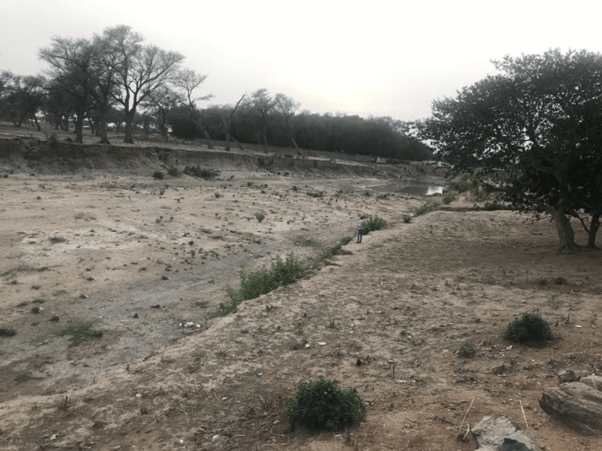
Dry river bed in the Far North region of Cameroon, in the Lake Chad Basin region of West Africa
Photograph credit: Manu Lekunze
This project builds on the Decolonising Peace Education in Africa Project (DEPA). We plan to draw on qualitative data and visual materials (from the DEPA project) relating to the impact of climate change on the lived experiences of people and places in Africa.
Project Objectives
- Develop teaching materials for a Key Stage 3 scheme of work, engaging with DEPA data and materials
- Produce accompanying teacher CPD (Continuing Professional Development) on how to use these materials
- Offer free online and face-to-face training to teachers
- Trial and evaluate teaching materials by teachers from diverse backgrounds
- Build sustainable links between the GA and teachers in Africa by hosting online networking meetings
Given that the climate crisis is an urgent global challenge, it is important to provide non-Eurocentric teaching materials on the climate crisis for schools (See APPG on Africa 2022). Our project will develop decolonial and EDI teaching materials on the climate crisis in the case study country of Cameroon, using DEPA materials and data. We aim to transform the content of climate change teaching (KS3) in UK schools, and also train a new generation of geography teachers who will be sensitised to decolonial curricula and pedagogies for school geography, EDI and anti-racism.
The materials produced as part of GICC will be accompanied by a teacher guide and CPD sessions offered to a large cohort of GA members and non-members.
Resources
Global Inequalities and the Climate Crisis
Global Inequalities and the Climate Crisis (GICC) is a curriculum resource that supports geography teachers to explore the relationships between global inequality and the climate crisis with Key Stage 3 classes, using the country of Cameroon as a case study.
The resource was produced in partnership with the Decolonising Education for Peace in Africa (DEPA) project, funded by the Economic and Social Research Council’s Global Challenges Research Fund as well as Impact Accelerator Account funding from the University of Lancaster.
Drawing closely on research from these academic projects enables the resources to foreground the voices and lived experiences of Cameroonian people themselves, at the same time as situating these experiences in a global context.
Go to the GICC Teaching Resource